Public WiFi vulnerabilities include fake hotspots, unsecured connections and attempts to intercept sensitive information. While HTTPS protects most web traffic, users should still verify the network name, avoid suspicious hotspots, disable automatic WiFi connections and file sharing, keep devices updated, and use a trusted VPN when accessing sensitive accounts or information.
The major security concern for Public internet is the Wifi vulnerability to hacking. Rogue users can easily crack the wifi key to access and control the wifi router to redirect the genuine users to malicious websites. Just like that, Kevin’s laptop was on the verge of being attacked while he was at a coffee shop in a meeting with a client. While discussing a project, he connected with the public wifi to research on the internet.
A hacker was also connected to the same network. Utilizing the wifi vulnerability to hacking, he cracked the Wifi password and gained access to the Wifi router. Now he can monitor all the user activity sharing the same network. He particularly targeted the users using NVMe protocol-based storage on their systems. He performed a MITM attack to redirect users into a malicious website by altering the DNS settings.
Kevin was redirected to that malicious website and the hacker was able to steal his login credentials. Being unaware of the attack, Kevin continued working online using the Wifi.
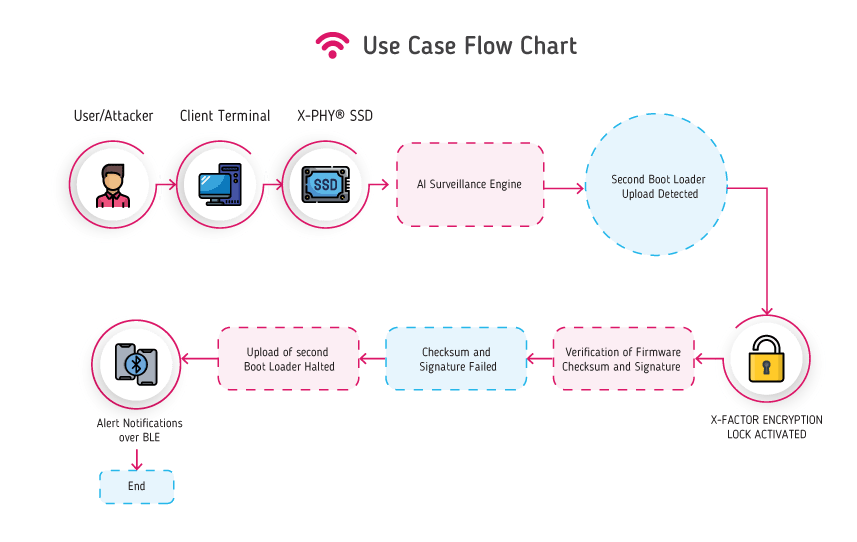
With the java applet, the hacker tried to unroot a second boot loader, to upload new firmware onto X-PHY® to get access to the data from the laptop.
The real-time AI surveillance detected the second boot loader and immediately triggered the Keycode Pro-X within the X-Factor Encryption feature. The file and pattern engine further verified the checksum and signature for the new firmware. Although it is detected as a trusted host device, the verification failed because the signature and the unique serial number of the X-PHY® did not match.
So, the boot loader was denied within a few seconds and a notification alert was sent to Kevin’s smartphone via pre-configured Bluetooth (BLE).
X-PHY Protection Method
1. The AI real-time monitoring activates the Keycode Pro-X upon detecting the upload of new firmware onto the X-PHY®.
2. File and pattern engine begin verification of checksum and signature of the uploading boot loader
3. The X-PHY® detects the source of the update in a genuine host device.
4. Verification of checksum and signature fails as the firmware is not signed for the unique serial number on the X-PHY®.
5. Halts the uploading of a second boot loader and sends alerts to the user over BLE.
More Posts
Loan collection teams are now squarely in the crosshairs of generative-AI fraud — voice clones of borrowers calling to settle debts they don’t owe, impersonated collections agents diverting payments, and AI-generated audio used to fabricate compliance disputes. The X-PHY® Deepfake Detector blocks these attacks in real time, on the agent’s endpoint, before they reach a payment or a regulator.

X-PHY has been selected as a finalist at the 2026 UK Cyber OSPAs, under the Outstanding Overseas Cyber Security Initiative category. This recognition places X-PHY alongside respected organisations and initiatives […]

SAN FRANCISCO, March 23, 2026 — Hardware cybersecurity pioneer, X-PHY Inc, today announced it has been named a winner in the 14th Annual Global InfoSec Awards, presented by Cyber Defense […]